PUBLICATIONS
Janus Worldwide presents its own solution: LEXA, a next-generation platform for translation management and quality assessment on a whole new level
In a world where speed and quality of translation is becoming a strategic advantage for businesses, Janus Worldwide reaffirms its reputation as a technology leader in the industry. We are pleased to introduce LEXA, a new cloud-based platform that combines the best solutions from the company and global machine translation providers into a single intelligent system.
LEXA doesn’t just translate texts – it selects the optimum engine, analyzes translation quality using the most advanced metrics, and preserves document structure. It’s the next step in making technology truly help people understand each other faster and more accurately, in line with the philosophy of MAIA + LLM = LEXA.
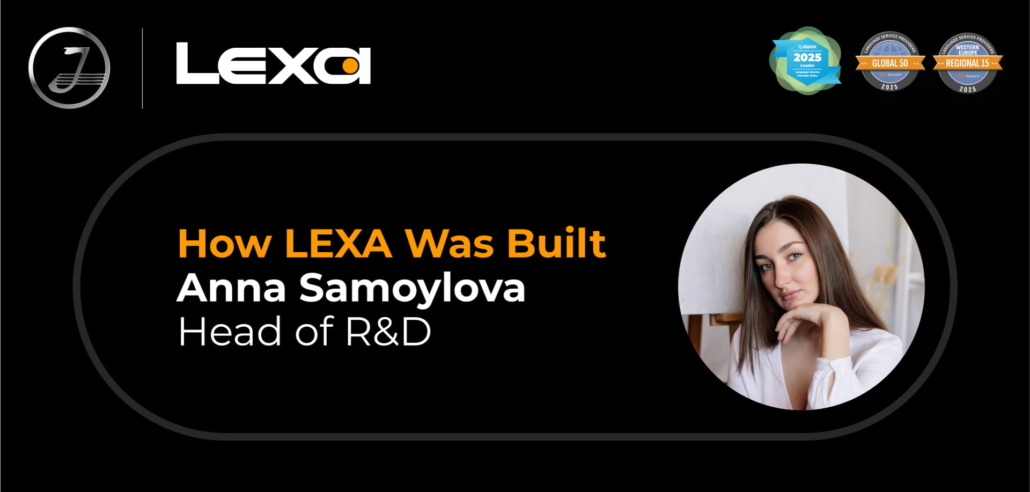
Today we will talk to Anna Samoylova, head of Research & Development, about how LEXA was created, what tasks it solves, and what the future holds for users.
Anna, please tell us how the idea to create the LEXA platform began?
The idea of creating a universal user console for machine translation arose during our participation in tenders for Johnson & Johnson and Ozon. We combined our own accumulated experience, in-house developments in the field of MT, and tender requirements, resulting in a platform that provides access to the best machine translation and AI engines, as well as MT quality assessment and other related tasks.
What are the key differences between LEXA and other existing translation systems?
LEXA is not just a platform for machine translation. It is a fully-fledged tool for organizing, optimizing and controlling the processes of working with multilingual content. Unlike standard systems, LEXA offers a number of unique features to improve the efficiency of translation processes.
- Janus’ NMT AI engine is fully customizable for specific topics and languages
- Intelligent provider selection: automatically determines the optimum engine for a specific language pair based on quality or cost
- REST API for integration and customization: provides easy integration into any business process with adaptability
- LiveChat for user support: allows quick exchange of information right in the interface
- Unified access to multiple MT providers: no need for separate subscriptions, and all engines are available within one tool
Can you tell us more about LEXA and MAIA?
AI-assisted translation is possible with LEXA and MAIA. LEXA is a user-friendly console for translation with AI, and stock and custom MT engines, while MAIA is a complete AI ecosystem that allows the creation and customization of prompts and selection of various large language models for translation tasks.
Why did you decide to combine different machine translation engines into one tool?
For the convenience of users. Each machine translation engine is more effective in different language pairs, so it is important to be able to choose the best tool for a specific task to achieve the highest possible translation quality.
How can users be assured of the translation quality? Tell us more about BLEU, TER and other evaluation metrics.
We use a number of common automatic metrics to evaluate machine translation quality. They allow us to compare the machine translation results with a reference (human or edited machine translation) and determine how close the result is to ideal.
The metrics we use are as follows:
BLEU (Bilingual Evaluation Understudy)
Compares machine translation to one or more benchmarks and estimates how many matches there are in terms of words and phrases. The more matches the are, the higher the BLEU. The value ranges from 0 to 100.
TER (Translation Edit Rate)
This shows how many edits need to be made to make the machine translation identical to the reference. It is measured in percentage terms. The lower TER is, the better the translation.
NIST (National Institute of Standards and Technology)
This is similar to BLEU, but takes into account the informativeness of n-grams. A match for a rare phrase is scored higher than a match for a frequent n-gram.
METEOR (Metric for Evaluation of Translation with Explicit ORdering)
This takes into account synonymy, stemming and word order. It compares words in both form and meaning.
ROUGE (Recall-Oriented Understudy for Gisting Evaluation)
This is often used in abstracting and summarization evaluation, but also applicable to translation.
RIBES (Rank-based Intuitive Bilingual Evaluation Score)
This evaluates word order preservation, and is especially important for languages with highly divergent syntax (e.g. English ⇄ Japanese).
HLEPOR/NLEPOR
These are improved metrics developed in China.
HLEPOR stands for Harmonic mean of Length penalty, Precision, n-gram position difference, Recall.
NLEPOR is its neural network modification.
Both metrics have a good sense of the balance between translation accuracy and completeness and are often used in academic environments.
Thus, a combination of these metrics provides the most objective and multidimensional quality control of machine translation, allowing not only evaluation of its technical compliance with the benchmark, but also account of its semantic and stylistic proximity, which is an important factor for text perception.
Can you tell us more about your own Janus NMT engine and its customization options?
The Janus NMT proprietary engine was originally developed with the possibility of full customization for a specific topic in mind. Its key features are training the model with client’s data. For customization, it is sufficient to provide our specialists with glossaries, translation databases and other bilingual files, and on their basis we optimize the engine for the most efficient work in a given area.
This approach is especially important for large corporate clients who need a particularly relevant style and high accuracy of translations.
For which clients and projects will LEXA be especially beneficial?
LEXA is a cloud-based AI console for various translation and linguistic tasks. It is intended for a wide range of users, including:
- Individual specialists who need a convenient and functional solution for their translation tasks
- Teams and large organizations that need a single tool for collaboration, quality control, integration with different MT engines and customization of workflows
LEXA is therefore suitable for everyone who needs to manage translations efficiently, from individual translators and editors to large language teams and corporate users.
How is the platform’s interface designed? Will it be user-friendly for users without technical experience?
The updated design fully complies with modern UX/UI trends and is based on the principles of intuitive navigation. Thanks to this, even specialists with no technical experience will be able to use all the LEXA features, from customizing machine translation to viewing statistics, as efficiently as possible.
What are LEXA’s development prospects for the coming year? Are there any plans to expand its functionality?
LEXA’s development plans include a significant expansion of the platform’s capabilities to increase the efficiency of machine translation work. Key directions include:
- Integration of new metrics for automatic MT quality assessment to provide more objective and multidimensional analysis of the result
- Training of MT engines directly in the LEXA interface for the most convenient customization of models according to specific domains and user requirements
- Exporting and uploading translation memories for easy data exchange, integration into other tools, and more efficient multilingual interaction
LEXA will therefore continue to evolve, making machine translation processes as convenient, transparent and efficient as possible.
What was the most interesting or challenging part of the project for you personally?
For me, the most exciting part of working on the project was actually the whole process, from making key decisions on functionality to the final stages of interface harmonization. This multi-stage work allowed both realization of a technically complex product, as well as making it as user-friendly as possible.

Head of the Research & Development department
Anna Samoylova
The department specializes in research and development in the field of machine translation, large language models and various automation technologies.
“I am sincerely glad that not only real professionals, but also enthusiastic and interesting people work in our team.”