PUBLICATIONS
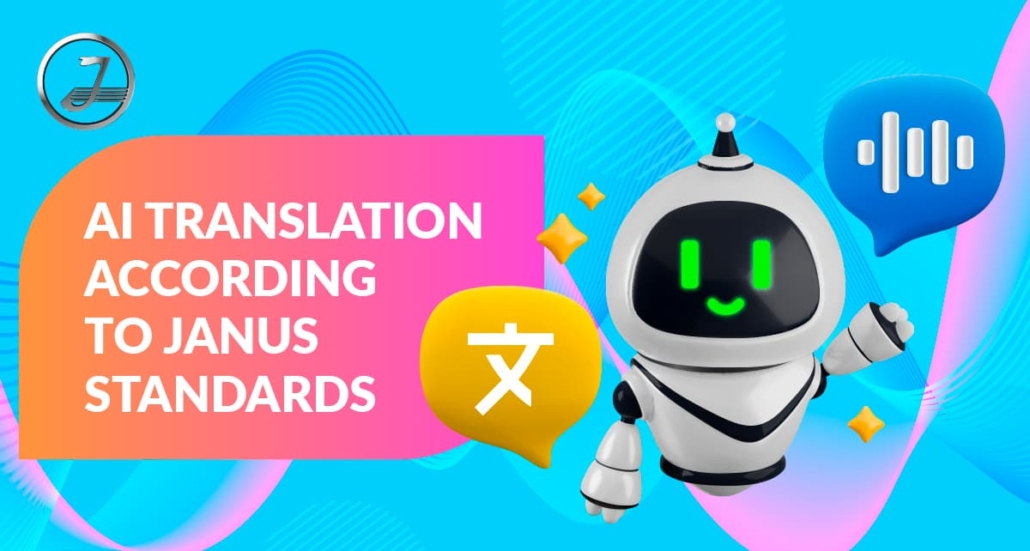
AI Translation According to Janus Standards: Controlled Technologies — Predictable Quality
Artificial intelligence has become firmly established in everyday localization processes. However, it is important to understand: not all AI translations are created equal. With increasing demands on quality, deadlines, and stylistic accuracy, machine translation alone is not enough for clients. They need it a real intellectual tool, adapted to their content, style and objectives.
At Janus Worldwide we have developed our own next generation AI translation service, based on the integration of LLMs (Large Language Models), client glossaries, extended context, and smart prompt management. Below, we’ll explain in detail the essence of this technology and how it fundamentally differs from basic solutions on the market.
What is AI translation from Janus?
AI translation in Janus is not just text generation by a neural network, a controlled process, in which:
- The client’s subject area, style and terminology are taken into account;
- extended context is applied, and not individual sentences;
- all formatting requirements and technical tags are observed;
- the RAG mechanism (retrieval-augmented generation) works for the integration of approved terms;
- AI settings are selected manually by the team depending on the type of content and the purpose of the translation.
We strive to ensure that the result obtained from the model is as close to the final version as possible. This is not just a draft, it is a translation that is almost ready for publication, requiring minimal editorial intervention.
Key features of Janus Technology
Enhanced context and structure preservation
Most basic AI solutions work on the principle of: “one sentence—one request”. This destroys the logic of the text and makes the translation mechanical. At Janus, we process whole blocks of segments, which allows:
- understanding of the context and topic;
- conveying the style of the original;
- providing naturalness and consistency of the translation;
- automatic saving of tags, formatting, and structure.
Connecting client glossaries (RAG)
Details matter in translation. Especially the terminology. Our AI translation takes into account approved glossaries and style guides, which eliminates errors in key terms. The RAG module analyzes the text and pulls it up relevant terms from the client’s database, making the translation accurate at the industry and brand level.
Smart prompt and creative control
We have developed prompt templates, which allow you to control the behavior of the model, rather than just using an unpredictable public model:
- In technical texts the style will be restrained and precise.
- In marketing materials the language will be more lively and expressive.
- In legal documents the wording, logic and terminology are observed.
Adapting the model to a specific client
One of the main differences between AI translation and Janus is customization for the client. We train models based on the client’s already approved translations, taking into account their style and vocabulary. For different topics and language pairs different adapters and configurations can be used, which ensures unrivaled accuracy and uniqueness of the text.
What happens when using “basic” AI translation?
Here’s a typical scenario when using standard machine translation without intelligent support:
- Sentences are translated separately, without understanding the general logic.
- Tags are broken, you have to manually correct the formatting.
- Client terminology is ignored, and this harms the quality.
- No style instructions—in one text, AI can write either dryly or too freely.
- The default model is used, without taking into account the industry, specifics and audience.
Result: the editor has to literally rewrite everything from scratch. This does not speed up the work; on the contrary, it complicates it and increases labor costs.
AI translation at Janus is the result of synergy of linguistic expertise, engineering precision, and deep adaptation to business needs. We don’t just implement AI: we make it a useful, controllable, and effective tool for our specialists and clients.
In the era of globalization, translation cannot be the same for everyone. That is why our approach is intelligent, individual and effective. Because quality is not a compromise. It is the standard. And we believe that technologies that help us achieve quality today must be manageable.
What does a Janus client get?
- Reduced editing time
- Reduced translation costs
- Consistent quality and terminological accuracy
- Stylistic adaptation to client requirements
- Flexibility and scalability—for any formats and volumes